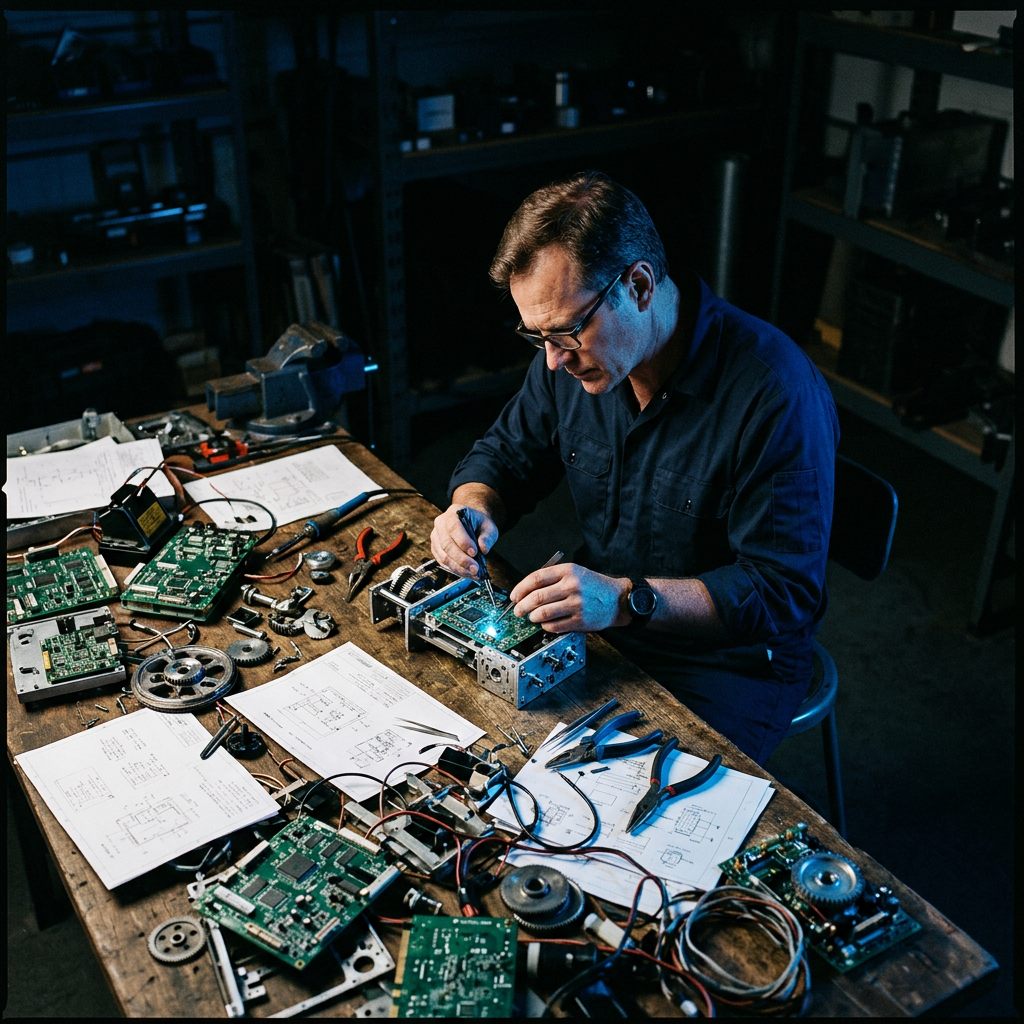
From Prototype to Manufacturing: What Every Hardware Startup Needs to Know
Introduction
Having a working prototype feels like a milestone. It is. But for hardware startup manufacturing, the prototype is maybe 20% of the journey. The gap between "it works on my bench" and "it ships from a factory" is where most early-stage founders lose their money, their timeline, and their investors' patience. Moving from prototype to production requires a completely different skill set than building the first version, and the decisions made in this phase determine whether the company scales or stalls.
Closing the Gap Between Prototype and Production-Ready Design
Most founders assume their prototype is close to the final product. It almost never is. The hardware product development stages between a validated prototype and a production-ready design involve hard trade-offs around materials, tolerances, and cost that reshape the product entirely.
Design for Manufacturing Is Non-Negotiable
Design for manufacturing (DFM) is the process of redesigning your prototype so it can actually be built at scale, affordably and repeatably. Skipping this step is the single most expensive mistake a hardware founder can make. A detailed DFM review before tooling begins can save tens of thousands of dollars in rework. Here is what DFM forces founders to confront:
Material substitution: Your prototype material probably will not scale. Find production-grade alternatives that meet spec at volume pricing.
Tolerance tightening: What works in a one-off fails at 10,000 units. Every dimension needs realistic manufacturing tolerances defined.
Assembly simplification: Reduce the number of screws, clips, and manual steps. Every extra assembly touch adds cost per unit.
Tooling requirements: Injection molds, custom dies, and jigs cost $5,000 to $100,000+. Know what you need before quoting suppliers.
Bill of materials cost planning: Lock down every component with pricing at target volume. A BOM that is off by 15% can destroy your margins before you ship a single unit.
Prototype Validation for Investors Requires Proof, Not Promise
Investors evaluating hardware expect more than a demo video. They want to see that the prototype has been tested under real conditions, that the design has been reviewed for manufacturability, and that the BOM reflects actual supplier quotes, not estimates from Alibaba listings. Prototype validation for investors means showing a credible path from where the product is now to where it needs to be at first production run.
This is where founders who protect their IP before raising capital gain a significant edge. A filed patent paired with a DFM-reviewed prototype signals that the founder understands the full picture, not just the technology.
Choosing Partners, Managing Cash, and Preparing to Raise
Once the design is production-ready, the next phase involves selecting the right manufacturing partner, managing cash flow against long lead times, and making the business fundable. This is where the operational reality of hardware separates it from software in ways that catch founders off guard.
How to Select a Manufacturing Partner Without Burning Your Runway
Manufacturing partner selection is one of the highest-stakes decisions a hardware founder makes. The wrong factory can deliver late, ship defective units, or hold tooling hostage if the relationship breaks down. Start with at least three quotes from vetted contract manufacturers. Compare not just unit pricing, but minimum order quantities (MOQs), tooling ownership terms, quality certifications like ISO standards for hardware manufacturing, and communication responsiveness.
Domestic versus overseas is not a binary choice. Many founders start with domestic or nearshore manufacturers for the first run (lower MOQs, faster iteration, easier communication) and then move overseas for volume. The key is understanding burn rate implications of each option. A cheaper per-unit cost overseas means nothing if a 14-week lead time forces a second bridge round that dilutes the cap table.
Always request sample runs before committing to a production order. A 50-unit pilot run at a slightly higher per-unit cost will reveal quality issues, packaging problems, and lead time realities that quotes on paper never show. This is not optional. It is risk management.
Financial Modeling and Fundraising Around a Hardware Business
Hardware startups burn cash before revenue in ways software companies do not. Tooling deposits, component inventory, packaging, freight, and compliance testing all require capital months before the first customer payment lands. Startup financial modeling for hardware needs to account for these upfront costs with precision, not optimistic estimates.
A credible financial model for a hardware company includes unit economics at three volume tiers (pilot, first production run, scale), a cash flow forecast that maps deposits and payment milestones to supplier timelines, and a clear breakeven analysis. Founders who cannot articulate their landed cost per unit, inclusive of freight, duties, and defect rate, will lose investor confidence fast. Building this kind of model does not require a finance background if the right tools are in place. A structured approach to startup financial modeling can bridge that gap.
Raising capital for hardware is harder than software. That is just the truth. The hardware vs software startup comparison comes down to capital intensity: investors know that hardware requires more money, takes longer to iterate, and carries inventory risk. To counteract this, the pitch deck needs to show that the founder has de-risked the manufacturing path. That means presenting real supplier quotes, confirmed MOQs, a DFM-reviewed design, and a financial model tied to actual data. Understanding startup funding stages helps founders time their raise correctly, because asking for money too early (before DFM) or too late (after runway is gone) both kill deals.
Inpaceline was built by a founder who has navigated this exact path, from patent filings and Shark Tank appearances to managing a hardware brand at scale. The platform's AI-powered financial tools and investor CRM help hardware founders model their costs and manage their fundraise in one place, instead of cobbling together spreadsheets and hoping the numbers add up.
Founders should also prepare for investor due diligence early. Hardware investors will dig into supplier agreements, tooling ownership, and inventory commitments. Having these documents organized before due diligence begins signals operational maturity. A monthly budget framework built from the start, as outlined in a year-one budget guide, keeps founders from scrambling when investors ask to see the books.
Once funding is secured, the pressure shifts to execution. The first production run needs to ship on time, at spec, within budget. Founders who have done the work on DFM, partner vetting, and financial modeling are the ones who hit that target. Those who skipped steps end up renegotiating with suppliers, redesigning packaging, or explaining delays to backers and investors. The path from scaling past the MVP stage is where operational discipline matters most.
Conclusion
The jump from prototype to manufacturing is where hardware startups either prove they are real businesses or discover they were science projects. Prioritize DFM before tooling, vet manufacturing partners with pilot runs, model financials against actual supplier data, and raise capital only after de-risking the production path. Early-stage founder resources that combine financial modeling, investor tools, and operational frameworks are not optional for hardware companies. They are survival tools. Inpaceline gives founders the structured system to manage all of this without guessing.
Start your 14-day free trial at Inpaceline and get the financial modeling, investor tools, and AI-powered guidance to take your hardware startup from prototype to production.
Frequently Asked Questions (FAQs)
How do hardware startups move from prototype to manufacturing?
Hardware startups transition by completing a design for manufacturing review, sourcing production-grade materials, selecting a contract manufacturer, running pilot production, and building a financial model that accounts for tooling, inventory, and lead time costs before committing to a full production run.
What do investors look for in hardware startup pitch decks?
Investors look for validated unit economics, real supplier quotes, a DFM-reviewed design, clear intellectual property protection, and a financial model showing the path to margin-positive production at realistic volume tiers.
How much does it cost to manufacture a hardware product?
Costs vary widely, but a first production run for a consumer hardware product typically requires $50,000 to $250,000 or more when factoring in tooling, component inventory, assembly labor, packaging, compliance testing, and freight.
What is the difference between a prototype and an MVP for hardware?
A prototype proves the technology works in a controlled setting, while an MVP for hardware is a production-representative version that can be manufactured repeatedly, sold to real customers, and used to validate market demand at a defined cost per unit.
How do hardware founders raise their first round of funding?
Hardware founders typically raise a pre-seed or seed round by demonstrating a working prototype, presenting a credible bill of materials with real supplier pricing, showing early customer interest or pre-orders, and modeling a clear path from first production to breakeven.